Collagen Peptides for Skin and Nails: A Clear Guide
A calm look at collagen peptides: how they work, what the best known studies found for skin and nails, and what is realistic to expect.
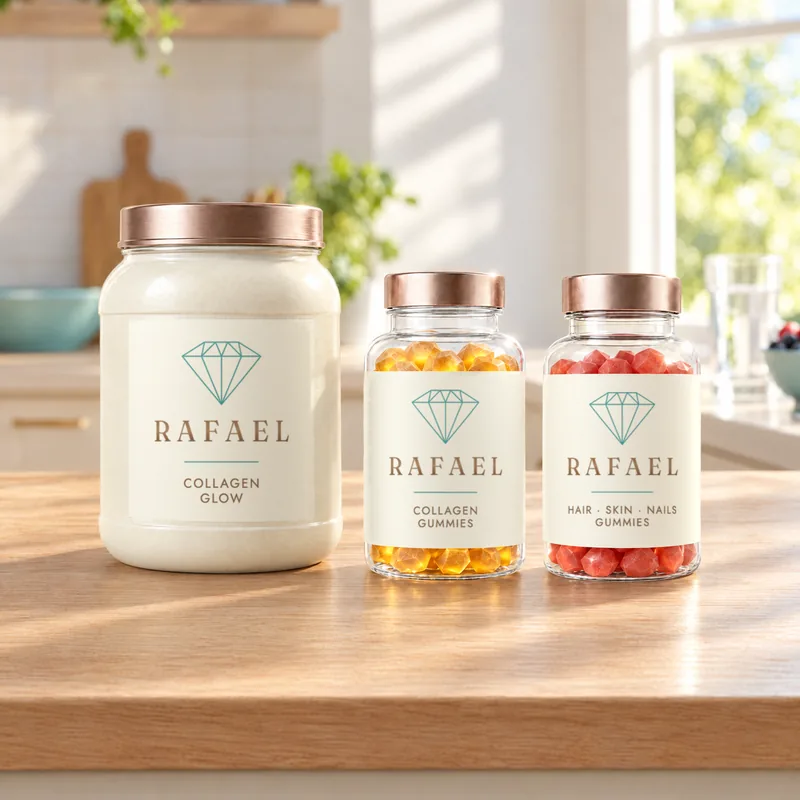
Collagen has moved from the dermatologist's office into the morning coffee. Scoops, gummies and drinks all promise skin and nail benefits from within. Some of that is supported by careful research, and some of it is hope. This guide walks through what collagen peptides are, what the better studies reported, and what is realistic to expect.
Why collagen matters for skin
Collagen is the main structural protein of connective tissue, and it makes up about 80% of the dry weight of human skin.1 It gives skin its support and resilience. With age, the cells that make collagen become less active and the skin's blood supply declines, changes that are linked to reduced elasticity and the formation of wrinkles.1
What hydrolyzed collagen peptides are
Whole collagen is a large, tightly wound protein. To make it easy to take as a supplement, it is broken down by hydrolysis into much smaller pieces called peptides. You will see these labeled as hydrolyzed collagen, collagen hydrolysate or collagen peptides.
The interesting part is what happens after you swallow them. In a study of healthy volunteers, small collagen-derived peptides, mainly one called prolyl-hydroxyproline, appeared in the blood after people took collagen hydrolysates and peaked within one to two hours.2 Other research has detected similar peptides in human blood about an hour after ingestion.1
Not all collagen peptides are the same. A 2023 review noted that some specific collagen sources appear more effective than others, even at the same dose and duration.1 That is why it helps to look for ingredients that have been studied by name.
What the studies reported for skin
Two well known placebo-controlled trials were published in Skin Pharmacology and Physiology in 2014.
In the first, 69 women aged 35 to 55 took 2.5 g or 5 g of specific collagen peptides, or a placebo, once daily for 8 weeks.3 Skin elasticity improved significantly in both collagen groups compared with placebo.3 Changes in skin moisture were seen in a subgroup but did not reach statistical significance.3
The second studied VERISOL®, a specific bioactive collagen peptide. 114 women aged 45 to 65 took 2.5 g or a placebo once daily for 8 weeks.4 The collagen group showed a 20% reduction in eye wrinkle volume compared with placebo at 8 weeks, and the effect was still present 4 weeks after they stopped.4 In a smaller subgroup, skin samples showed 65% more procollagen type I and 18% more elastin than the placebo group.4
What the research reported for nails
A 2017 study in the Journal of Cosmetic Dermatology followed 25 people with brittle nails who took 2.5 g of VERISOL® daily for 24 weeks.5 Nail growth rate increased by 12% and the frequency of broken nails fell by 42%.5 64% of participants achieved an overall clinical improvement, and 88% experienced an improvement at a check 4 weeks after they stopped.5
It is worth knowing the limits. This was an open-label study with no placebo group, so everyone knew they were taking collagen.5 The results are promising, and they are best read as an early signal rather than a final answer.
The bigger picture
When researchers pool many trials, the picture is encouraging but not settled. A 2021 meta-analysis of 19 randomized trials with 1,125 participants found favorable effects of hydrolyzed collagen on skin hydration, elasticity and wrinkles.6 A 2023 meta-analysis of 26 trials with 1,721 participants found improvements in hydration and elasticity, while also noting several biases in the included studies and calling for larger trials.1
A 2025 analysis in The American Journal of Medicine looked more closely. Across 23 trials, collagen improved hydration, elasticity and wrinkles overall. Yet studies without funding from pharmaceutical companies, and those rated high quality, did not show significant effects.7 The authors concluded that current evidence does not support collagen to prevent or treat skin aging.7 We think that honesty is useful. Collagen is a supportive habit, not a guarantee.
Consistency is the whole story
Every study above used a daily dose taken for weeks, not days. The skin trials ran for 8 weeks34 and the nail study for 24 weeks.5 In the 2023 meta-analysis, use for longer than 8 weeks was associated with more favorable results than shorter use.1
Nails are a slow, visible record of change, so give them time. A simple way to stay consistent is to attach collagen to something you already do every morning, such as your coffee or your skincare routine.
Powder or gummies
The format matters less than the peptide, the amount and your habit. A few points to weigh:
- Powder dissolves into coffee, tea or a smoothie and suits people who already have a morning drink ritual.
- Gummies need no mixing and travel easily, which helps some people stay consistent.
- Check the label for the name of the peptide and the grams per serving, so you can compare it with the amounts used in the studies above.
- Choose the one you will actually take every day. A format you enjoy is the one that works for your routine.
Our Collagen Glow powder and Collagen Gummies are both made with VERISOL® collagen peptides, so you can choose the format that fits your morning. The results described in this article come from published studies of the ingredient, not from studies of our products.
Realistic expectations
- Changes reported in studies were measured with instruments over weeks and may be subtle to the eye.
- Results vary from person to person.
- Collagen supplements are made from animal sources such as fish, cattle, chicken or pigs, so they are not vegan.1
- If you are pregnant, breastfeeding, managing a health condition or taking medication, check with your doctor before adding a supplement.
The takeaway
- Hydrolyzed collagen peptides are small pieces of collagen, and some of them can be detected in the blood after you take them.12
- Studies of specific peptides such as VERISOL® reported improvements in skin elasticity, eye wrinkle volume and brittle nails over 8 to 24 weeks.345
- The wider evidence is mixed, and the strongest independent studies have not confirmed clear effects.7
- Consistency matters more than format. Pick powder or gummies based on what you will take every day.
This article is for general information and is not medical advice.
These statements have not been evaluated by the Food and Drug Administration. This product is not intended to diagnose, treat, cure, or prevent any disease.
Sources
- Effects of Oral Collagen for Skin Anti-Aging: A Systematic Review and Meta-Analysis (Pu SY et al. Nutrients. 2023;15(9):2080). Nutrients (MDPI), via PubMed Central. Source
- Identification of food-derived collagen peptides in human blood after oral ingestion of gelatin hydrolysates (Iwai K et al. J Agric Food Chem. 2005;53(16):6531-6). Journal of Agricultural and Food Chemistry, via PubMed. Source
- Oral supplementation of specific collagen peptides has beneficial effects on human skin physiology: a double-blind, placebo-controlled study (Proksch E et al. Skin Pharmacol Physiol. 2014;27(1):47-55). Skin Pharmacology and Physiology (Karger), via PubMed. Source
- Oral intake of specific bioactive collagen peptides reduces skin wrinkles and increases dermal matrix synthesis (Proksch E et al. Skin Pharmacol Physiol. 2014;27(3):113-9). Skin Pharmacology and Physiology (Karger), via PubMed. Source
- Oral supplementation with specific bioactive collagen peptides improves nail growth and reduces symptoms of brittle nails (Hexsel D et al. J Cosmet Dermatol. 2017;16(4):520-526). Journal of Cosmetic Dermatology (Wiley), via PubMed. Source
- Effects of hydrolyzed collagen supplementation on skin aging: a systematic review and meta-analysis (de Miranda RB et al. Int J Dermatol. 2021;60(12):1449-1461). International Journal of Dermatology (Wiley), via PubMed. Source
- Effects of Collagen Supplements on Skin Aging: A Systematic Review and Meta-Analysis of Randomized Controlled Trials (Myung SK, Park Y. Am J Med. 2025;138(9):1264-1277). The American Journal of Medicine (Elsevier), via PubMed. Source
For general information only, not medical advice. If you are pregnant, nursing, taking medication or have a medical condition, please check with your doctor before use.
Keep reading
Bakuchiol vs. Retinol: What to Know Before You Choose
Two ingredients, one goal: smoother-looking skin. Here is what the research says, and how to choose the one that suits your routine.
Read →
How to Build a Simple Wellness Ritual, Outside and Within
A few unhurried minutes a day, built around habits you already have.
Read →
Hair Shedding vs. Hair Loss: What Is Normal and What Is Not
Losing some hair every day is part of a healthy cycle, and knowing what normal looks like makes it easier to notice when something deserves a closer look.
Read →